

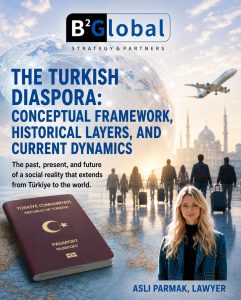
Due to its unique location, Turkey continues to serve as a bridge between Asia and Europe, and is a country that receives many immigrants thanks to its valuable traditions and customs, tolerant attitude, history, experiences, hospitality, and inclusive nature.
However, our country, due to its historical, geographical, and cultural location, functions as a bridge between Asia and Europe; this unique position has made the country a center for both receiving and sending immigrants for centuries. Its traditional values, culture of social solidarity, understanding of hospitality, and historical experience of multiculturalism have led to a relationship between Turkey and the phenomenon of migration that is not only quantitative but also qualitative.
The “concept of migration” is a highly dynamic structure and can change over time. While our country, due to its location, has experienced many migration movements, it has also recently been a country of emigration.
On the other hand, the concept of migration is not static; On the contrary, it has a dynamic structure that is constantly transforming in line with historical conditions, economic needs, political developments, and individual preferences. Looking specifically at Turkey, while the country was predominantly a recipient of immigration for many years, there has been a significant increase in outward migration, especially in recent times. This situation reveals that the Turkish diaspora is not only a historical phenomenon but also a current and continuous social reality.
The concept of “Turkish diaspora” (Turks living abroad or expatriate Turks), which is the subject of this article, is a term used to describe the estimated global population of Turks who have migrated from Türkiye and former Turkish (Ottoman) territories. In other words, those who migrated to other countries after the establishment of the Republic of Turkey are defined as the “Turkish diaspora.”
Every migration is actually expected to be “temporary.” However, people’s needs, the phenomena of adaptation over time, or individual preferences have made migrations permanent. It is precisely at this point that our citizens who initially chose to emigrate from Turkey, perhaps due to the needs of that era, have, over time, adopted a perspective shaped by an established order and choose not to return, opting to continue their lives in the same direction.
To give an example from around the world, particularly to Germany, there was a significant influx of migrants following the labor agreement signed between Turkey and Germany on October 30, 1961. Perhaps initially considered temporary and adopted for labor purposes, this migration has become permanent over time, resulting in the formation of a Turkish diasporain Germany over a period of almost 50-60 years.
Furthermore, according to the Turkish Statistical Institute’s (TÜİK) 2022 International Migration Statistics, the number of people migrating from Turkey to abroad increased by 62.3% compared to the previous year, while the number of people migrating from abroad to Türkiye decreased by 33.2%.
This shows that it is possible to speak of the existence of a Turkish diaspora in countries that receive a large influx of migrants. While in everyday usage the term “diaspora” is often considered synonymous with “citizens living abroad” or “expatriates,” academic literature encompasses a broader framework. William Safran’s classic work emphasizes the symbolic/emotional ties that diaspora communities forge with their homeland, the collective memory of the homeland, belonging, and (sometimes) the “myth of return.” What makes a diaspora a diaspora is not merely the act of migrating; it is the continuity of relationships established with the homeland (language, culture, religion, family ties, media, associations, economic networks) while building a new life in the place of migration.
The Turkish diaspora should not be seen as the product of a single wave of migration. While the framework of “those who migrated abroad after the establishment of the Republic of Turkey” is important in the modern sense, the historical traces of Turkish presence extending from the Balkans to the Middle East also bring to the forefront a broader history of population mobility of “Turkish-speaking/socially connected” people.
However, in contemporary literature, the term “Turkish diaspora” primarily refers to modern-era migrations from Turkey to Western Europe, North America, and other regions. The most visible and foundational example of these modern-era migrations is the labor migration that accelerated after the Labor Agreement signed between Germany and Turkey on October 30, 1961.
While the agreement initially aimed to meet the need for temporary labor, in subsequent years it transformed into a permanent community through family reunification, the birth of new generations, and settled life practices. This historical turning point is explicitly referenced in both the official narratives of the German Foreign Ministry and in academic literature.
Ahmet İçduygu, in evaluating the economic, social, and political consequences of labor migration from Turkey to Germany, emphasizes that this migration has long-term effects not only on individuals but also on Turkey’s societal transformation.
Therefore, understanding the Turkish diaspora requires considering both the institutional arrangements, discrimination/integration debates, and citizenship regimes in the countries of migration (e.g., Germany), and the transformations Turkey has experienced as a “country of origin” (remittances, brain drain, political representation, preservation of cultural ties, etc.).
The growth and institutionalization of the diaspora has also transformed the relationship between states and the diaspora. Studies arguing that diaspora policies in Turkey have been addressed more systematically since 2010 focus particularly on institutionalization, rights, preservation of cultural ties, and multi-dimensional diaspora engagement. In this context, the YTB’s “multi-dimensional and inclusive diaspora policy” approach reflects the current institutional discourse aimed at strengthening ties with the diaspora.
At this point, the diaspora is not merely about “those who leave”; it is an area that builds bridges between the two countries, facilitates cultural exchange, and generates social capital in the long term. For a sound analysis of this area, both statistical data (such as Turkish Statistical Institute) and qualitative field studies (oral history, archives, ethnography) should be used together.
In addition to the quantitative size of the Turkish diaspora, its qualitative impact is becoming increasingly important. Diaspora communities contribute in multifaceted ways to both the countries they live in and their homeland through cultural representation, public diplomacy, academic production, economic relations, and civil society activities.
In this context, the Turkish diaspora is no longer just a subject of migration sociology; it has also become an important component of foreign policy, cultural diplomacy, and human capital policies. Within this conceptual and historical framework, the importance of academic studies in the field of the Turkish diaspora is steadily increasing. In particular, documenting diasporahistory, making visible migrant experiences, and preserving intergenerational memory are among the fundamental goals of studies in this area.
It is precisely at this point that it is meaningful to mention a leading figure who has been conducting high-quality and pioneering studies in the field of the Turkish diaspora for many years: Dr. Işıl Açelhan.
Dr. Işıl Açelhan is a lecturer at Bahçeşehir University and received her master’s and doctoral degrees from Bilkent University. Her academic areas of expertise include migration movements from the Ottoman Empire to North America and Europe, the Turkish diaspora, and Turkey-US relations. Açelhan’s work offers a holistic perspective that examines the Turkish diaspora not only as a numerical community but also in its historical, cultural, and political dimensions.
In 2019, Dr. Açelhan completed her postdoctoral studies at the Fondazione per le Scienze Religiose Giovanni XXIII research center in Bologna, Italy, and subsequently served as a visiting professor at the Ali Vural Ak Global Islamic Studies Center at George Mason University. During this period, she has implemented many public and socially impactful projects such as documentary projects, exhibitions, and memorial works related to Turkish immigrants in the USA.
In this respect, Açelhan’s work is among the high-quality examples that bring academic production together with society and concretize the memory of the diaspora. Dr. Işıl Açelhan is noteworthy not only for her academic work but also for her workshops and seminars on historical and cultural relations between Turkey and the USA, public diplomacy, and diasporaawareness. After many years of working abroad, her decision to return to Turkey after approximately twenty years to utilize her knowledge and experience in her home country constitutes a significant example of reverse brain drain. Today, she teaches at universities and public institutions and organizations and provides consultancy services.
In this context, Dr. Işıl Açelhan is not only an academician who studies the Turkish diaspora; she is also a name that directly contributes to the development of this field, setting an example with her work supported by international awards and scholarships. Her academic and social output demonstrates how multifaceted and effective Turkish diaspora studies can be.
In conclusion, the phenomenon of the Turkish diaspora is closely linked to both Turkey’s past and its future. Strengthening this field academically, supporting high-quality research, and making exemplary figures visible are of great importance. Dr. Işıl Açelhan’s work, in this sense, offers an inspiring example for both young academics and all stakeholders working in the field of diaspora studies.
For anyone interested in the Turkish diaspora and wishing to contribute to this field, benefiting from this accumulated knowledge will be a significant gain. In this respect, I hope it will serve as an example for everyone, and I would like to conclude my writing by introducing the work of our esteemed professor to all students, academics, and others interested in and serving in the field of “Turkish diaspora” who wish to benefit from her work.
Sources